

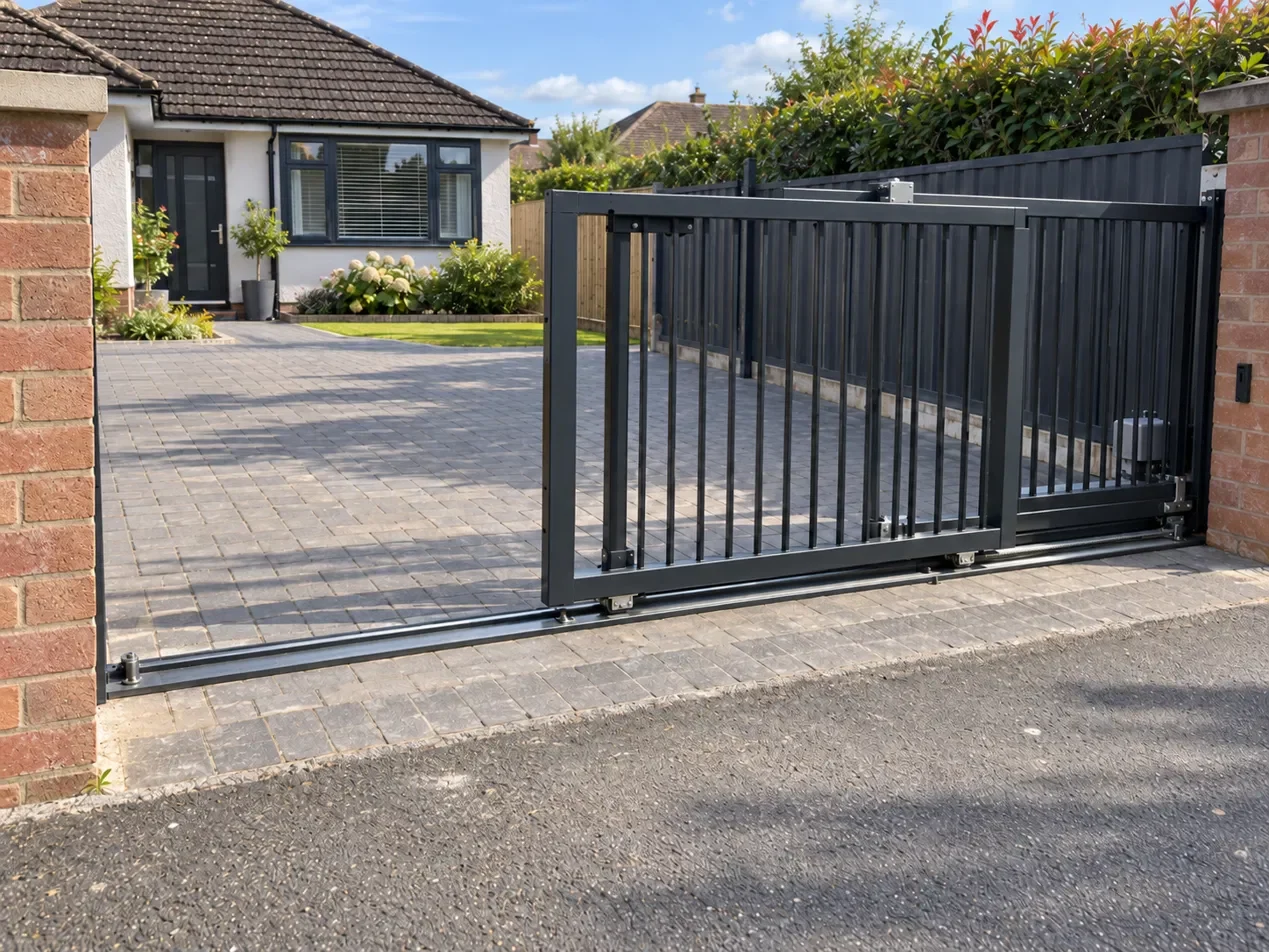
Metal Telescopic Sliding Gate
Metal Telescopic Sliding Gate-
£1,500.00+ Price depends upon SizesView Gate
- Quick View
Frequently Asked Questions
How does a steel telescopic gate open differently from a one-piece slider?
A telescopic steel gate divides the moving gate into two or more coordinated leaves. As it opens, those leaves overlap and park alongside one another rather than occupying one continuous panel length beside the entrance. The shorter parked arrangement is deeper, however, so both the available boundary length and the space behind the gate line need checking.
What should I measure beside the opening for a metal telescopic gate?
Measure the unobstructed length along the proposed opening side and the depth available for the nested leaves. Include the positions of pillars, walls, fencing and changes in ground level. The final layout also needs allowances for overlap, guides, stops and drive equipment; the opening width alone cannot establish the required parking space. Send a sketch and photographs for an initial assessment.
Will the telescopic mechanism increase the price of a steel gate?
Separate leaves require additional fabrication and matched running, guiding and coordinating components, which can add cost compared with a simpler steel slider. That does not establish a fixed premium: dimensions, infill, finish, automation and groundworks all affect the quotation. Compare proposals for the same clear opening and finish, and check whether installation and automation are included.
Does a metal telescopic driveway gate need solid infill panels?
Telescopic describes the opening arrangement, not the infill style. An open-bar design can still use overlapping leaves, provided the frames and mechanism are designed for that configuration. Bar spacing, frame proportions and the appearance where leaves meet should be considered together. The available design needs confirming against your opening rather than assuming every existing metal gate pattern can be copied unchanged.
Can my existing single-panel steel gate be converted to telescopic operation?
Do not assume the current panel can simply be divided and reused. A conversion would need compatible leaf frames, support points, guides and a mechanism that coordinates their travel, as well as enough depth for the stacked leaves. Existing posts, track and automation may not suit that arrangement. An assessment can establish whether retaining any components is practical or a purpose-built gate is preferable.
Which parts of an overlapping steel gate need access for maintenance?
The layout should leave service access to the rollers, guides and the components that coordinate the leaves, including those partly hidden when the gate is parked. Keep the travel and parking areas clear of debris and follow the equipment supplier's servicing instructions. Rubbing between leaves or a change in their alignment should be checked rather than treated as normal telescopic movement.
Discuss Your Metal Telescopic Gates
Made to your opening and site conditions.