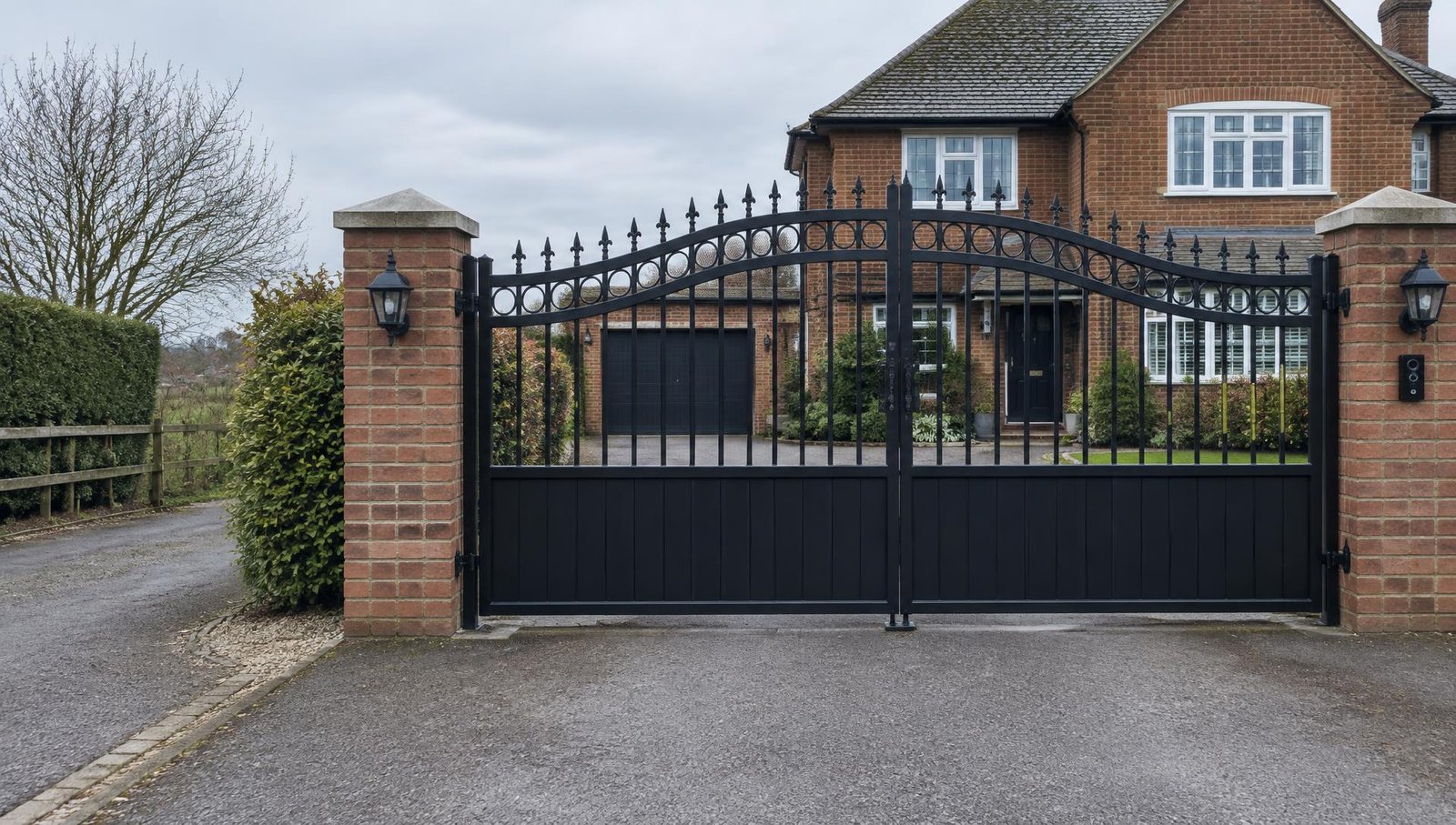


Garden Gates Made to Your Exact Opening
Garden gate openings are rarely tidy. Pillars lean, paths slope, and the gap between a house wall and a boundary fence is whatever the builder left. A fixed-size gate off a shelf almost never fits it, so the difference gets packed out with timber or left as a gap you squeeze past.
We measure the opening you actually have and build to it in our own UK workshop, in steel, aluminium or composite. We can fit it with our own team, or supply the gate for your own fitter.
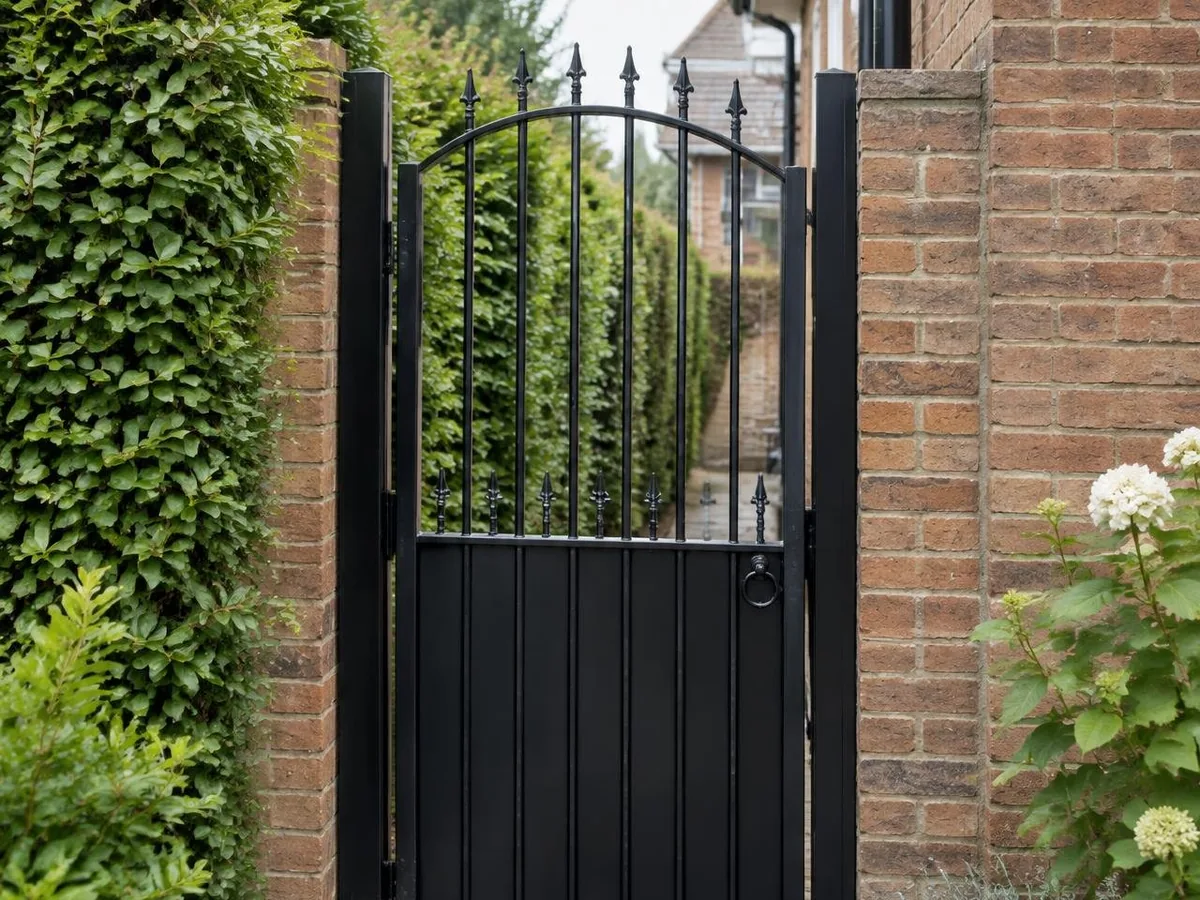
Choosing the Right Garden Gate
A garden gate does a smaller job than a driveway gate, and the decisions are different. Most of it comes down to where the gate sits, what it needs to keep in or out, and whether it has to match something you already have.
- Pedestrian and side access gates
- The gate down the side of the house, between the front garden and the back. Usually a single leaf, often tall, and frequently the only way into a back garden without going through the house, which is why the lock matters more than the look. Browse Side Gates
- Front garden and path gates
- Shorter, lighter and more decorative, set between pillars, walls or railings at the front of the property. Here the gate is part of the frontage, so the pattern and finish usually lead the decision. Browse Garden Gates
- Matching an existing driveway gate or fence
- If you already have a driveway gate, railings or a particular fence panel, we can build a garden gate to the same pattern, height and colour. Send photographs with your measurements and we will work from them. If you are planning both at once, our driveway gates guide covers the larger gate.
- Single or double leaf
- Most garden openings take a single leaf. Past roughly 1.5 metres wide, a single gate starts to sag on its hinges over time and needs a heavier frame, so a pair of smaller leaves is often the better build. We will tell you which your opening suits when we quote.
- Height, privacy and visibility
- A tall solid gate gives privacy and hides the bins; an open bar gate keeps the garden feeling light and lets you see who is at the gate. Infill density is the dial between the two, and you can mix them, for example open bars above a solid lower panel. Height next to a highway can need planning permission, which our driveway gates guide explains.
Not sure what your opening needs? Send us photographs and measurements and we will advise before you commit to anything. Request a quote
Materials
A garden gate leads an easier life than a driveway gate. It is lighter, it is opened by hand rather than a motor, and nothing drives into it. What it does get is constant daily use, so hinges, latches and the finish around the handle take more wear than the frame ever will. Our metal vs composite gates comparison sets the materials side by side in more detail.
Steel
The widest choice of designs, from scrollwork and spear finials to plain vertical bars and solid privacy panels. Heavy enough to feel solid in the hand, and the powder-coat shade is picked from the RAL range, so a new gate can be matched to ironwork you already have. The usual choice where the gate needs to match existing ironwork.
Browse Garden GatesAluminium
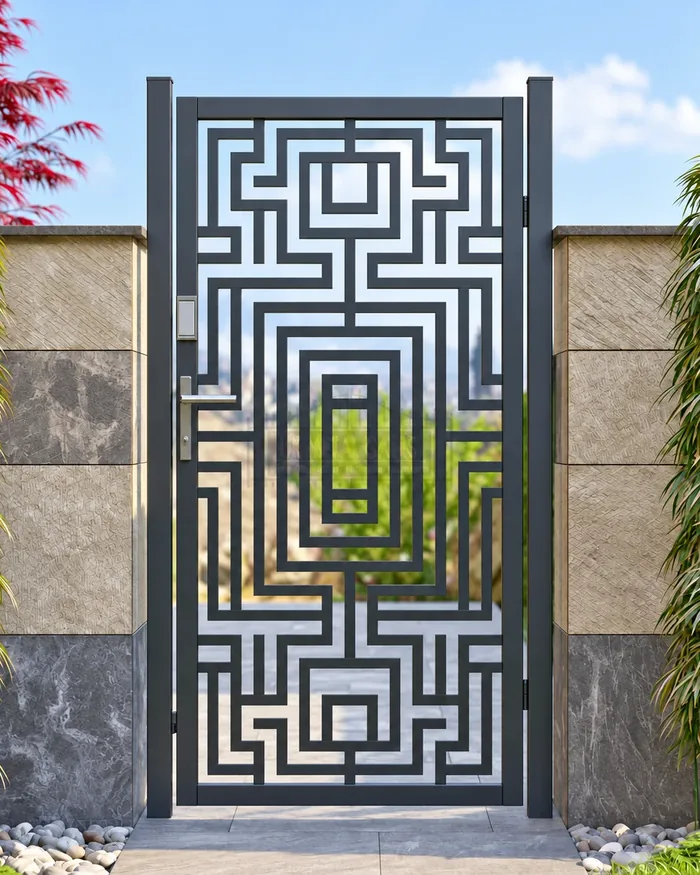
Noticeably lighter to swing, which is worth having on a gate opened several times a day, and easier on hinges and posts over the years. It also copes better than untreated steel with the damp, shaded side passages these gates tend to live in, and with salt air near the coast. Also the easiest material for cut-panel and geometric designs.
Browse Aluminium Garden GatesComposite
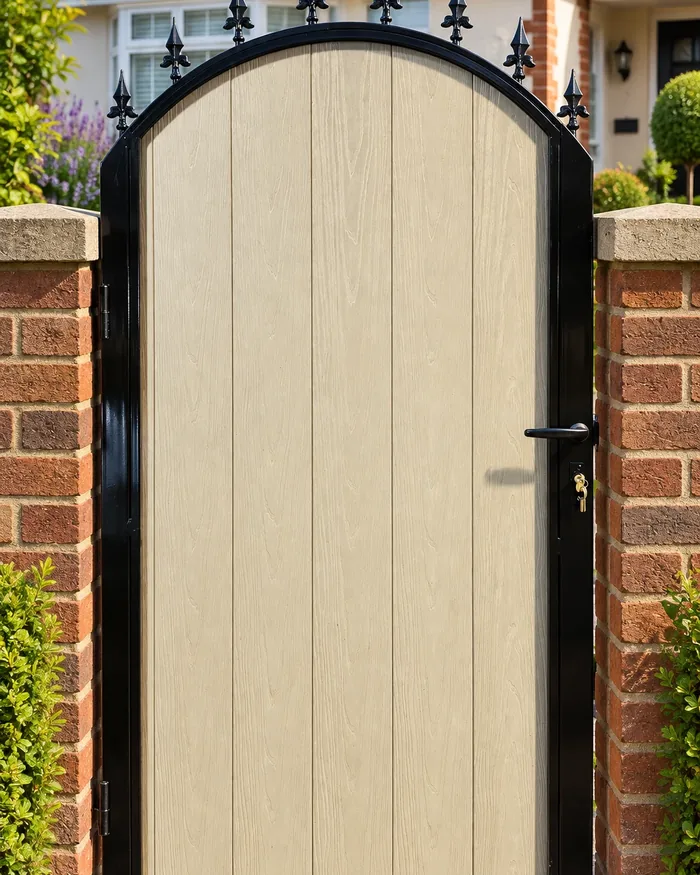
Wood-effect panels in a metal frame, giving a solid private gate with much less upkeep than real timber, which usually needs regular treating. A common choice for side gates where the gate is tall, solid, and permanently in the damp shade between two buildings.
Browse Composite Garden GatesWrought iron
The scrollwork and finial patterns that suit a Victorian or Edwardian frontage. Usually the answer when a new gate has to drop into a run of original railings without reading as a replacement. Many of the designs in our garden gates range are made in this style.
Browse Garden Gates
Security and Privacy
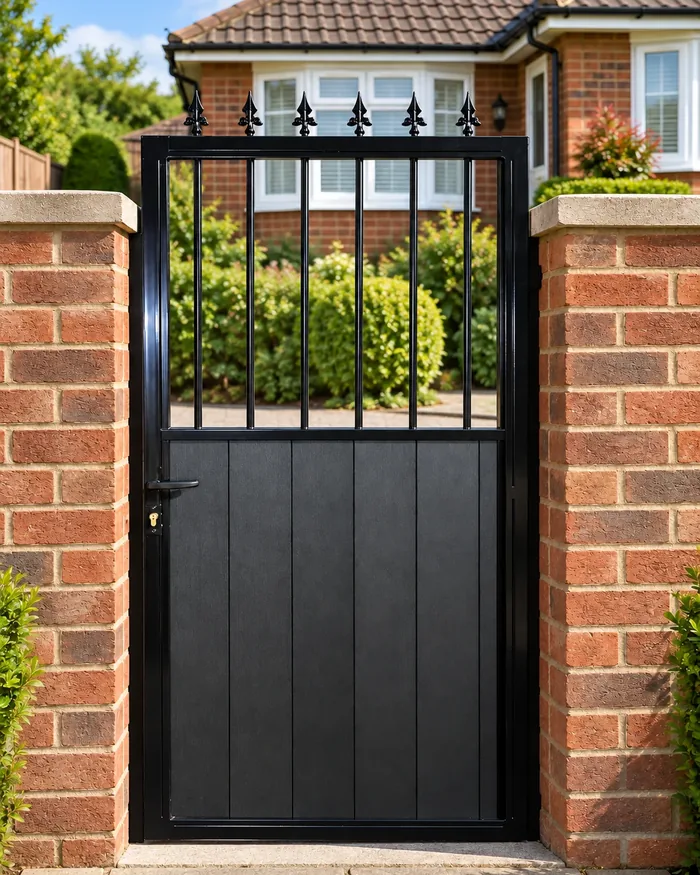
A garden gate is often less about security than about containment. A gate that a toddler cannot open, or that a dog cannot push through or squeeze under, is a different specification from one meant to slow somebody down, and the two pull in opposite directions: child-safe latches are deliberately awkward, and secure locks are deliberately awkward in a different way.
Worth thinking about before you order:
- Gap under the gate, which decides whether a small dog can get beneath it
- Bar spacing, which decides whether a cat or a child can get through it
- Latch height and type, including child-resistant and lockable options
- Whether the gate should be lockable from both sides, or only from inside
- Hinge direction and whether the gate can be lifted off its hinges
- Infill density, which sets how much of the garden is visible from the street
Side gates in particular tend to be specified for a lock rather than a look, since they are often out of sight of the road. Tell us what the gate is for and we will specify the ironmongery to match.
Powered Locks and Entry Control
Most garden gates are opened by hand and there is no reason to change that. Where power earns its place on a pedestrian gate, it is almost never about saving effort, because the gate is light and you are already on foot. It is about deciding who gets through it when you are not standing there.
That changes the equipment. A pedestrian gate rarely needs a motor to swing the leaf at all. What it usually needs is a lock that can be released remotely, which is a much smaller and cheaper piece of kit than anything fitted to a driveway gate:
- Electric release latch
- A keeper in the frame that unlatches on a button press, so the gate can still be pushed open by hand. The usual starting point for a side gate.
- Magnetic lock
- Holds the gate shut while powered and lets go when power is cut. Worth knowing that behaviour cuts both ways: the gate releases in a power cut, which suits some situations and not others.
- Keypad or fob reader
- Entry on a code or a fob, which suits a gate used by cleaners, dog walkers, a gardener or family who should not all have keys. Codes can be changed; keys have to be collected back.
- Audio or video entry
- A panel at the gate and a handset indoors, so you can see and release. If you already have an intercom on a driveway gate, a pedestrian gate can often be added to the same system rather than running a second one.
- Swing actuator
- Where the leaf genuinely does need to open itself, perhaps for step-free access, a small arm sized for a pedestrian leaf does the job. This is the exception on a garden gate, not the rule.
Two things worth settling before you order. First, how the gate behaves from the inside: if it is the only route out of a back garden, it should open from within without hunting for a key or a code. Second, where the power and cabling come from, since a side passage rarely has either and the run back to the house is often the fiddliest part of the job.
Tell us who needs to get through the gate and how often, and we will specify the locking to suit. Request a quote
What a Garden Gate Costs
The opening size and the material set the baseline. Detail in the design adds to it, and so does the locking, since a keyed lock or an electric release costs more than a simple latch. A plain single steel gate to a standard side passage sits at the lower end; a tall bespoke composite gate with a matching side panel and a keyed lock sits higher.
There is no standard size to price against, so there is no price list. Every quote is worked out from the opening you actually have. Quotes are free and carry no obligation.
Request a free quote: send the opening width and height, a photograph of the gap, and what you need the gate to do.
Matching Your Boundary
A garden gate is rarely on its own. It usually sits in a run of railings, a fence, or a wall, and the gate is the part people look at. We can build a gate to match an existing railing pattern, or make the gate and the railings together so the spacing, height and finish line up properly.
If you are matching to something already in place, photographs of the existing ironwork alongside your measurements tell us more than a description does. Browse Railings
Once it is fitted, a powder-coated gate needs very little: an occasional wash and the hinges and latch kept lubricated. The annual checklist in our gate maintenance guide is written around driveway gates, but the steel, aluminium and ironmongery sections apply equally to a garden gate.
Measuring a Garden Gate Opening
Tolerances bite harder here than on a driveway. An opening three metres wide can absorb a centimetre of error without anyone noticing; a side passage of 820mm cannot, because the frame, the hinge knuckle and the latch all take their cut from the same gap. Measuring a few millimetres generously is the single most common reason a pedestrian gate will not close.
What to record:
- The narrowest point of the opening, not the widest. Brick courses bulge, render builds up and fence posts twist, so measure at the top, the middle and the bottom and tell us the smallest of the three.
- What each side is actually made of. A gate hung off a brick pier, a timber fence post, a rendered block wall or a house wall with a soil pipe on it are four different fixings, and it changes what we build into the frame.
- Ground level across the opening and beyond it. Paths often step, slope to a drain or rise towards a back garden. A gate has to clear the highest point of its own swing, so a step on the opening side sets the gap underneath.
- Which way it needs to open, and what is in the way. A wheelie bin, a downpipe, a meter box, a window sill or a path too narrow to take the open leaf all decide the hinge side before taste does.
- Headroom, if the gate sits under a porch, an archway or a first-floor overhang.
Photographs help more than a description, particularly of the two sides the gate will fix to. Our how to measure guide covers the basics, and if the opening is awkward we would rather survey it than guess.
Does a Garden Gate Need Planning Permission?
Usually not, and for a reason worth understanding: the permitted height limits are set well above where most garden gates sit. A tall side gate built for privacy is typically around 1.8 metres, which is already under the two metre allowance that applies away from the road, so the question never arises.
The case that does catch people out is the front. A gate on a boundary next to a road is held to a much lower limit than the one at the side of the house, and a decorative front gate can pass it without looking tall at all. Conservation areas and listed buildings are the other exception, and there the material and pattern can matter as much as the height.
We have set out the height thresholds and the exceptions in full in our driveway gates guide, and the same rules apply to a garden gate, so we have not repeated them here. It is general guidance either way: your local planning authority is the one that decides, and it is worth a call before you order anything tall or anything at the front.
Installation
We offer installation across the UK through our own installation team, including hanging the gate and setting posts, and we can also supply the gate on its own if you would rather use your own fitter or fit it yourself. A single garden gate into existing pillars is a straightforward job; new posts into a path or driveway surface need groundwork, so tell us what the gate is fixing to when you ask for a price.
Delivery of garden gates is estimated at up to 10–15 working days, and side gates at up to 3–5 working days, depending on the gate, current manufacturing times and your area. See our installation service and delivery information for current times and charges.
Frequently Asked Questions
Can you match a garden gate to my existing railings or driveway gate?
Yes, and it is one of the most common requests we handle. Send photographs of the existing ironwork with your measurements and we will build the gate to the same pattern, height and colour. Browse Railings
My side passage is an awkward, uneven gap. Can you still make a gate for it?
Yes. Leaning pillars, a sloping path, a brick wall on one side and a fence post on the other are all normal for side passages, and the gate is cut to the opening rather than the other way round. Our how to measure guide explains what to record, or we can carry out a site survey as part of the quote.
How long does a garden gate take?
Garden gates are estimated at up to 10–15 working days and side gates at up to 3–5 working days, though these are estimates and move with manufacturing times, gate size and delivery area. An express service is available. See our delivery information.
Do you deliver and install outside London?
Yes, we deliver and install across the UK. Installation is optional, so you can also have the gate supplied on its own. See our installation service.
Can I get a garden gate that locks?
Yes. Gates can be specified with a keyed lock, a lockable latch, a drop bolt, or a padlock hasp, and can be made lockable from one side or both. Tell us how you want to use the gate and we will specify the ironmongery with the quote.
Ready to plan your gate?
Send us your opening size and a photograph of the gap and we will help with the rest.